Earth Angel: The Penguins' 1954 Recording and Songwriters
The Story Behind the Song · The Penguins, 1954
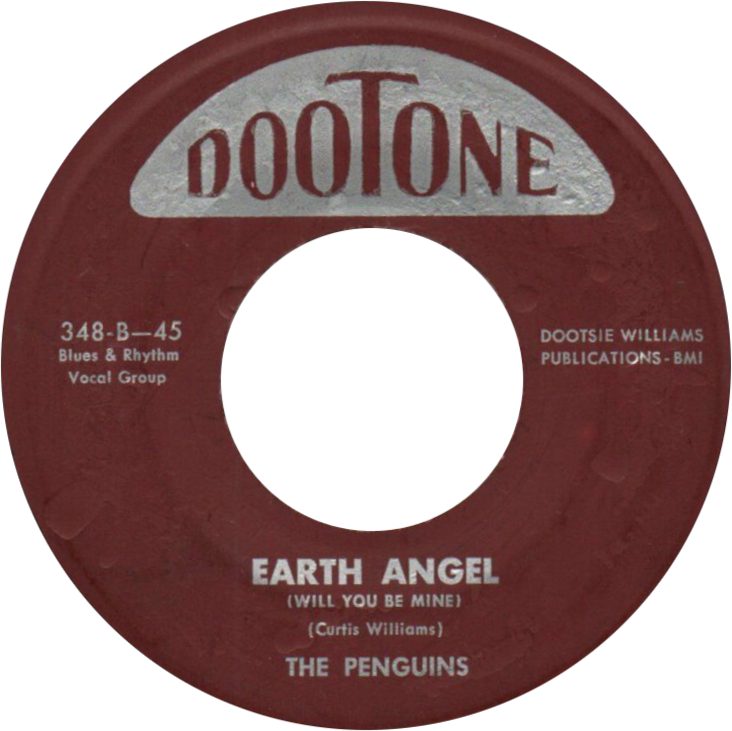
The maroon DooTone label of the original 1954 pressing — "Earth Angel" as the B-side of catalogue number 348 · DooTone Records label scan, public domain as typography
Where did the Penguins record Earth Angel?
The most famous doo-wop record ever made was taped in a garage behind a house on West 30th Street in South Los Angeles. The garage belonged to Ted Brinson, a mail carrier who had played bass in the Jimmie Lunceford and Andy Kirk orchestras and who was related to the Penguins' lead singer, Cleve Duncan. Brinson had built a studio in there around a single-track Ampex, and the label owner Dootsie Williams used it for sessions. The drummer, Preston Epps, muffled his kit with pillows. Curtis Williams played piano.
It came out in September 1954 on DooTone 348 — as the B-side. The record was pressed to sell "Hey Señorita"; "Earth Angel" was the flip. Disc jockeys turned it over in October, and by the Billboard issue dated February 5, 1955 the record stood at No. 1 on the R&B Best Sellers in Stores chart, in its eighth week there, while sitting at No. 8 on the pop Best Sellers chart at the same time. It held that No. 8 pop position into late February.
Then came the lawsuits, and they are documented in the trade press rather than in legend. Billboard reported in May 1955 that Jesse Belvin had sued Dootsie Williams, contending that Curtis Williams — the only name on the label — had not written the song. On May 13, 1955, Judge Arnold Praeger of the Los Angeles Superior Court ordered Dootsie Williams to place all money received from "Earth Angel" and two other songs into trust while the matter was decided. By the accounts of researchers who have worked through the case, the court in 1957 held Belvin to be the song's author, after which he assigned his rights to Williams. Gaynel Hodge is reported to have won recognition as a co-composer separately. Today the Library of Congress credits all three men.
One correction is worth making, because it is repeated everywhere. The Crew-Cuts' cover version is usually said to have reached No. 3 and buried the original. Billboard's pages say otherwise: the Crew-Cuts' "Earth Angel" peaked at No. 8 on the pop Best Sellers chart — the identical position the Penguins reached. The confusion appears to come from Cash Box, which combined every version of a song into a single chart line and had "Earth Angel" at No. 5 in March 1955 credited jointly to both groups.
The Penguins never had another hit anywhere near it. But in 1959, when Art Laboe began packaging old singles as "Oldies But Goodies," the garage recording came back onto the national listings — the first stirring of a revival that would keep this music on American radio for the next half-century.
On the record
- Recorded in Ted Brinson's home garage studio, West 30th Street, South Los Angeles, in the late summer of 1954. No exact session date survives.
- Released September 1954 as DooTone 348, the B-side of "Hey Señorita."
- No. 1 on Billboard's R&B Best Sellers in Stores and No. 8 on pop Best Sellers in Stores, both in the issue dated February 5, 1955.
- Credited on the label to Curtis Williams alone; today credited to Jesse Belvin, Gaynel Hodge and Curtis Williams.
- Added to the Library of Congress National Recording Registry in 2004.
🎵 We recreate this sound — 1950s doo-wop and slow-dance ballads, new albums every week on the lovesong1950s channel.
Music on this channel is composed and produced with AI tools; the songs, stories, and artwork are original works created for lovesong1950s.
Sources: Billboard, February 5, 1955 — pop and R&B Best Sellers (issue scan) · Billboard, May 21, 1955 — "'Earth Angel' Suit Injunction" (issue scan) · Billboard, March 19, 1955 — Crew-Cuts at No. 8 pop (issue scan) · Jim Dawson, "The Recording of 'Earth Angel'" (Doo-Wop Society of Southern California) · Marv Goldberg's R&B Notebooks: The Penguins · Library of Congress, National Recording Registry essay. Chart positions are cited to the specific Billboard chart and issue date, because the magazine ran several separate charts in these years and a record could sit at No. 1 on one and No. 8 on another.
More from this series: the lovesong1950s home page · every post from August 2026


Comments
Post a Comment