September 1, 1950: The FCC Picks a Side in the Color TV War
Today in 1950 · Friday, September 1, 1950
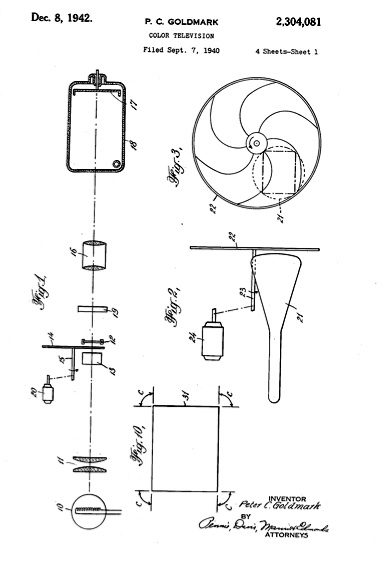
Patent diagrams of Peter Goldmark's CBS field-sequential color television system with its spinning color-filter disk · U.S. patent drawing, public domain, via Wikimedia Commons
On this day in 1950, the Federal Communications Commission issued its First Report on Color Television Issues — and sent shockwaves through the young television industry by finding CBS's color system the best of the three it had tested. The competitors were giants: CBS, RCA, and Color Television Inc., each with a different scheme for putting color into American living rooms.
CBS's field-sequential system was gloriously mechanical: spinning discs of red, blue and green filters, one behind the camera lens and one in front of the home receiver's picture tube. It produced beautiful color — and was completely incompatible with the millions of black-and-white sets already sold. The FCC's report proposed 'bracket standards,' receivers built to handle both monochrome and CBS color, and estimated that at sales of five to six million sets a year, 40 percent of receivers in use could get CBS color within a year.
The September 1 report endorsed CBS's technology while deferring formal adoption; that came on October 11, 1950. CBS color went commercial in June 1951 — and died within months, doomed by that incompatibility, before the compatible NTSC standard won the war in 1953. Today's report was the moment the color-TV battle turned from engineering into policy.
Also on this day
- North Korea launched the Great Naktong Offensive, its final all-out assault on the Pusan Perimeter, attacking along five axes simultaneously.
- Mao Zedong publicly warned against any invasion of North Korea.
- Congress passed the 'Doctors' Draft' bill authorizing the conscription of physicians.
- Born this day: Phil McGraw — television's future 'Dr. Phil.'
🎵 On the radio that week: America’s No. 1 song was “Goodnight Irene” by Gordon Jenkins and The Weavers (Billboard best sellers) — TIME magazine sniffed that the Weavers' polished version was 'dehydrated' and 'prettied up' — America bought it anyway. That sound never really left — we recreate 1950s doo-wop and slow-dance ballads every week: read the stories behind our songs or listen on the lovesong1950s channel.
🎬 At the movies: “Sunset Boulevard” kept filling houses, with silent-era legends — Erich von Stroheim, Buster Keaton, Cecil B. DeMille — playing versions of themselves.
⚾ In sports: Brooklyn's Gil Hodges crushed four home runs off four different pitchers on August 31 at Ebbets Field — 5-for-6, nine RBIs — while the surging Yankees swept past Detroit into first.
Sources: Eyes of a Generation: the CBS-RCA color feud · US National Archives, Prologue: color TV (PDF) · Wikipedia: September 1950 · Billboard best-seller charts, 1950 (issue scans) · Variety National Boxoffice Survey, 1950 (Lantern scans) · Retrosheet 1950 game logs and box scores. Every fact above is drawn from the records linked here — no dramatization, no invented details.
More from this series: Today in 1950 — the daily archive · every post from September 2026


Comments
Post a Comment