Why Do Fools Fall in Love: Frankie Lymon's 1956 Hit
The Story Behind the Song · Frankie Lymon and the Teenagers, 1956
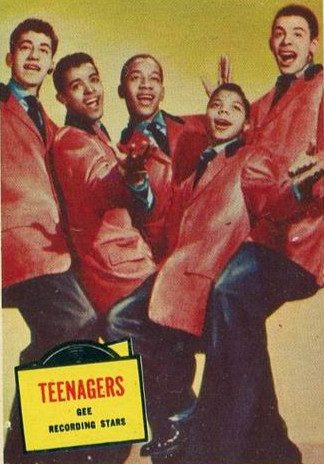
Frankie Lymon and the Teenagers on their 1957 Topps Hit Stars card — Herman Santiago, Jimmy Merchant, Sherman Garnes, Frankie Lymon and Joe Negroni · Topps, 1957, copyright not renewed, public domain
Frankie Lymon and the Teenagers: the first recording
Frankie Lymon was thirteen years old at the session. The group was still calling itself the Premiers when it recorded at Bell Sound Studios on West 54th Street in New York in November 1955, with Jimmy Wright's tenor saxophone behind them, and the song was still called "Why Do Birds Sing So Gay?" It came out in the last week of December 1955 as Gee 1002, under a new group name.
By the Billboard issue dated March 31, 1956 it was No. 1 on the R&B Best Sellers in Stores chart and No. 1 on R&B Most Played by Jockeys; a fortnight later it reached No. 6 on the pop Best Sellers chart, and No. 7 on the Top 100. A boy who had not finished eighth grade was the biggest voice in American popular music.
He died twelve years later, at twenty-five, of a heroin overdose, on the bathroom floor of his grandmother's apartment in upper Manhattan. Most accounts give the date as February 27, 1968; some say the 28th. What followed took far longer than his career had. Three women came forward as his widow, and the case ran to a written appellate opinion in 1989: Elizabeth Waters, Emira Eagle and Zola Taylor of the Platters. A surrogate had ruled for Waters on a common-law marriage; the Appellate Division reversed and awarded the estate to Eagle, on the strength of the church ceremony she and Lymon had gone through at Fort Gordon, Georgia in June 1967.
The songwriting fight took even longer. The copyright had been registered in 1956 naming the label man George Goldner and Lymon as the authors; in 1965 a letter to the Copyright Office replaced Goldner's name with that of Morris Levy, the Roulette Records owner, and the song passed to Levy's publishing company. In 1987 two surviving Teenagers, Jimmy Merchant and Herman Santiago, sued. A jury found in 1993 that they and Lymon had written it and that Goldner had not. The Second Circuit reversed in 1996 — not on the merits, but because the claim had come too late under the Copyright Act's three-year limit. The same opinion records that the jury found Goldner and Levy had deliberately concealed royalties, and that Levy threatened the plaintiffs with physical force; he was convicted of extortion in the late 1980s and sentenced to ten years.
The record itself takes two minutes and twenty seconds and sounds like nothing had ever gone wrong.
On the record
- Recorded November 1955 at Bell Sound Studios, 237 West 54th Street, New York; released as Gee 1002 in the last week of December 1955.
- Frankie Lymon was born September 30, 1942, and was 13 at the session.
- No. 1 on R&B Best Sellers in Stores and R&B Most Played by Jockeys — Billboard, March 31, 1956. Pop peak No. 6 on Best Sellers (April 14, 1956); No. 7 on the Top 100.
- Estate case: Matter of the Estate of Frank J. Lymon, 151 A.D.2d 248 (New York Appellate Division, First Department, June 6, 1989).
- Authorship case: jury verdict for Merchant and Santiago in 1993, reversed as time-barred in Merchant v. Levy, 92 F.3d 51 (2d Cir. 1996).
🎵 We recreate this sound — 1950s doo-wop and slow-dance ballads, new albums every week on the lovesong1950s channel.
Music on this channel is composed and produced with AI tools; the songs, stories, and artwork are original works created for lovesong1950s.
Sources: Billboard, March 31, 1956 — R&B charts (issue scan) · Billboard, April 14, 1956 — pop Best Sellers (issue scan) · Matter of Estate of Frank J. Lymon, 151 A.D.2d 248 (1989) · Merchant v. Levy, 92 F.3d 51 (2d Cir. 1996) · Marv Goldberg's R&B Notebooks: The Teenagers · Smithsonian Magazine on Frankie Lymon. Chart positions are cited to the specific Billboard chart and issue date, because the magazine ran several separate charts in these years and a record could sit at No. 1 on one and No. 8 on another.
More from this series: the lovesong1950s home page · every post from August 2026


Comments
Post a Comment