September 30, 1950: The Paper That Linked Smoking to Lung Cancer
Today in 1950 · Saturday, September 30, 1950
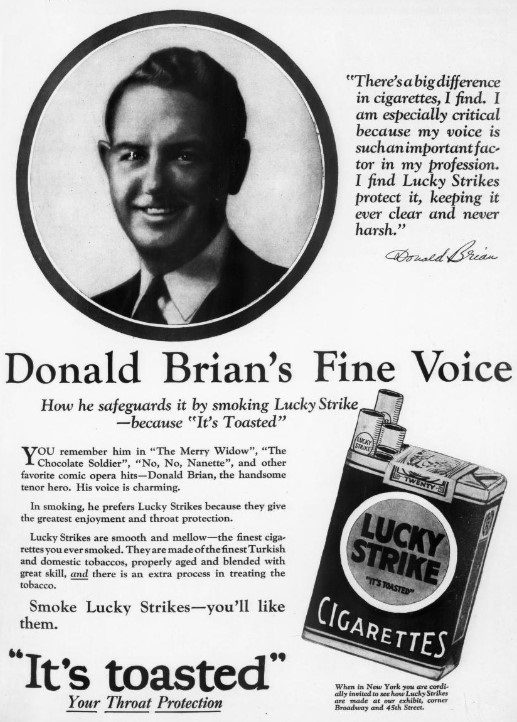
A Lucky Strike cigarette advertisement from Vogue, 1927 — the kind of glamour the Doll-Hill study began to undo · American Tobacco Company advertisement, 1927, public domain, via Wikimedia Commons
On this Saturday in 1950, the British Medical Journal published a paper whose reverberations have saved more lives than almost any document of the century: 'Smoking and Carcinoma of the Lung: Preliminary Report,' by Richard Doll and A. Bradford Hill. The original, still preserved online, opens from an alarming statistic — lung cancer deaths in England and Wales had risen from 612 in 1922 to 9,287 in 1947, a fifteen-fold surge no one could explain.
Doll and Hill's method became a model for modern epidemiology: a case-control study comparing 1,465 lung-cancer patients against age-matched control patients across twenty London hospitals, each interviewed in detail about their smoking habits. The pattern was unmistakable, and the authors said so in words of deliberate plainness: 'cigarette smoking is a factor, and an important factor, in the production of carcinoma of the lung.' The tobacco industry would spend decades fighting that sentence; the science never budged.
The same day in Paris, at a public session at the Sorbonne, the first International Astronautical Congress opened — delegations from eight countries, convened by Alexandre Ananoff, resolving to create an international federation for astronautics and interplanetary flight, seven years before Sputnik. One newspaper day; two futures announced: the end of the cigarette century, and the beginning of the space one.
Also on this day
- President Truman signed NSC 68, the strategy document that framed US Cold War containment policy for a generation.
- Chinese Premier Zhou Enlai declared publicly that China would not 'stand by idly' if its neighbor were invaded — a warning Washington discounted, three weeks before Chinese armies crossed the Yalu.
- Afghanistan-Pakistan border tensions erupted over the Baluchistan frontier.
🎵 On the radio that week: America’s No. 1 song was “Goodnight Irene” by Gordon Jenkins and The Weavers (Billboard best sellers) — its 13 straight weeks at No. 1 was the longest run of the 1950s. That sound never really left — we recreate 1950s doo-wop and slow-dance ballads every week: read the stories behind our songs or listen on the lovesong1950s channel.
🎬 At the movies: The box office belonged to “My Blue Heaven” — which also introduced a newcomer named Mitzi Gaynor — with “Sunset Boulevard” at No. 2.
⚾ In sports: Philadelphia's free-fall cut a 7.5-game lead to a single game over Brooklyn entering the final day, while the idle Yankees clinched the pennant when Cleveland routed Detroit 12-2.
Sources: Original BMJ paper (PDF) · PMC: the 1950 study in context · IAF: the 1950 Paris congress · China MFA: Zhou Enlai's Sep 30 warning · Billboard best-seller charts, 1950 (issue scans) · Variety National Boxoffice Survey, 1950 (Lantern scans) · Retrosheet 1950 game logs and box scores. Every fact above is drawn from the records linked here — no dramatization, no invented details.
More from this series: Today in 1950 — the daily archive · every post from September 2026


Comments
Post a Comment